
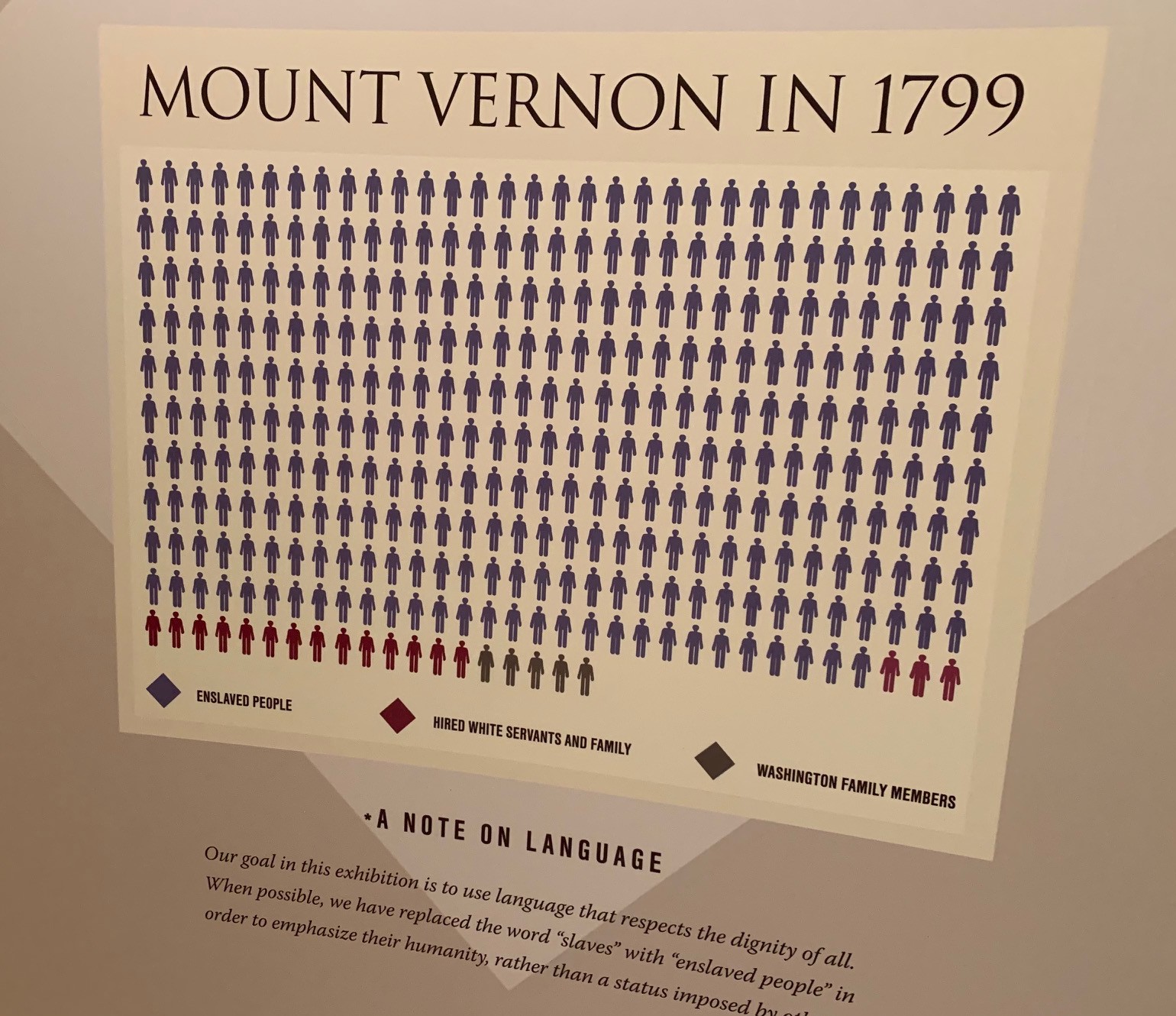
Today was a full day at Mount Vernon. An excellent program for us as we had a tour of the Lives Bound Together gallery that encapsulated the stories of enslaved persons that were at Mount Vernon in 1799. Of all the artifacts and pedagogy this one panel depicted above said so much. It graphically shows the ratio of enslaved people in comparison to hired white servants and the Washington family. They easily could have buried this completely lopsided ratio in some statistical text. However, seeing it displayed visually this way drives the point home that there is no way the Washington plantations (farms) could have functioned without enslaved servants. This visual pedagogy is jarring and shocking. I looked at it another way when Jason Burrows, Mount Vernon research archeologist said: “Think of this place like a large black neighborhood.” I have been to Mount Vernon many times, but when he said this one quote, it flipped that place on its head for me. If I were giving the tour of the gallery, this would be one of the first things I would share.
We talked a long time about the delicate and complex story of Mount Vernon and its enslaved persons. Even the term enslaved has been changed in the narrative from slaves to give a sense of humanity back to the people that endured it. It was clear that this is the toughest subject of Mount Vernon. After all, it involves one of the founding fathers of the country, but he was also a slave owner. You cannot reconcile the two nor can you make excuses or water down the injustice. Despite this, Washington’s viewpoints changed about slavery. This shifting of thought is laid out in great detail. I think it tells a richer story that at least Washington was conflicted later in life about this horrible institution.
That leads me to what I thought the other great quote was for the day. Mason (I did not catch his last name), the Digital Producer for Mount Vernon, said: “people are trying to get simple answers about complicated questions.” So many museums can relate to this dilemma. How much can you share with visitors without overwhelming some or all of them? If you don’t share enough information, then that simple answer becomes incomplete and misleading. The visitor then walks out thinking that the entire story is the simple story when it usually is a far deeper kaleidoscope of narratives. I talked about this in my blog yesterday when I saw the same dilemma at the National Memorial Holocaust Museum. I struggle with this all the time when I give tours, and I think this museum today will force me to look closer at my storytelling and make sure I have given visitors a clear, concise but rich experience from differing perspectives. No easy task.
 Dave's Museum Journeys
I couldn’t agree more, Dave—that graphic, and Jason’s characterization of Mount Vernon as a large black neighborhood turned the entire way I thought about not only Mount Vernon but other similar sites on its head. It’s so exciting and freeing to have a new way to think about something–a new angle and new information to lay over what we thought we already knew.
LikeLike
Not an easy task at all, but necessary. I just spent a week there studying this very subject. Moving and life changing. Thanks for sharing.
LikeLike