
We have been taught in our readings and through our seminar that universals get at the heart of why people care about a story. I am a firm believer that loss is one of the most powerful of universals. What we saw today in the United States Holocaust Memorial Museum is the most horrific and sickening slaughter of our fellow humans on record. Millions of people were systematically exterminated under one of the most oppressive ideologies of the 20th Century.
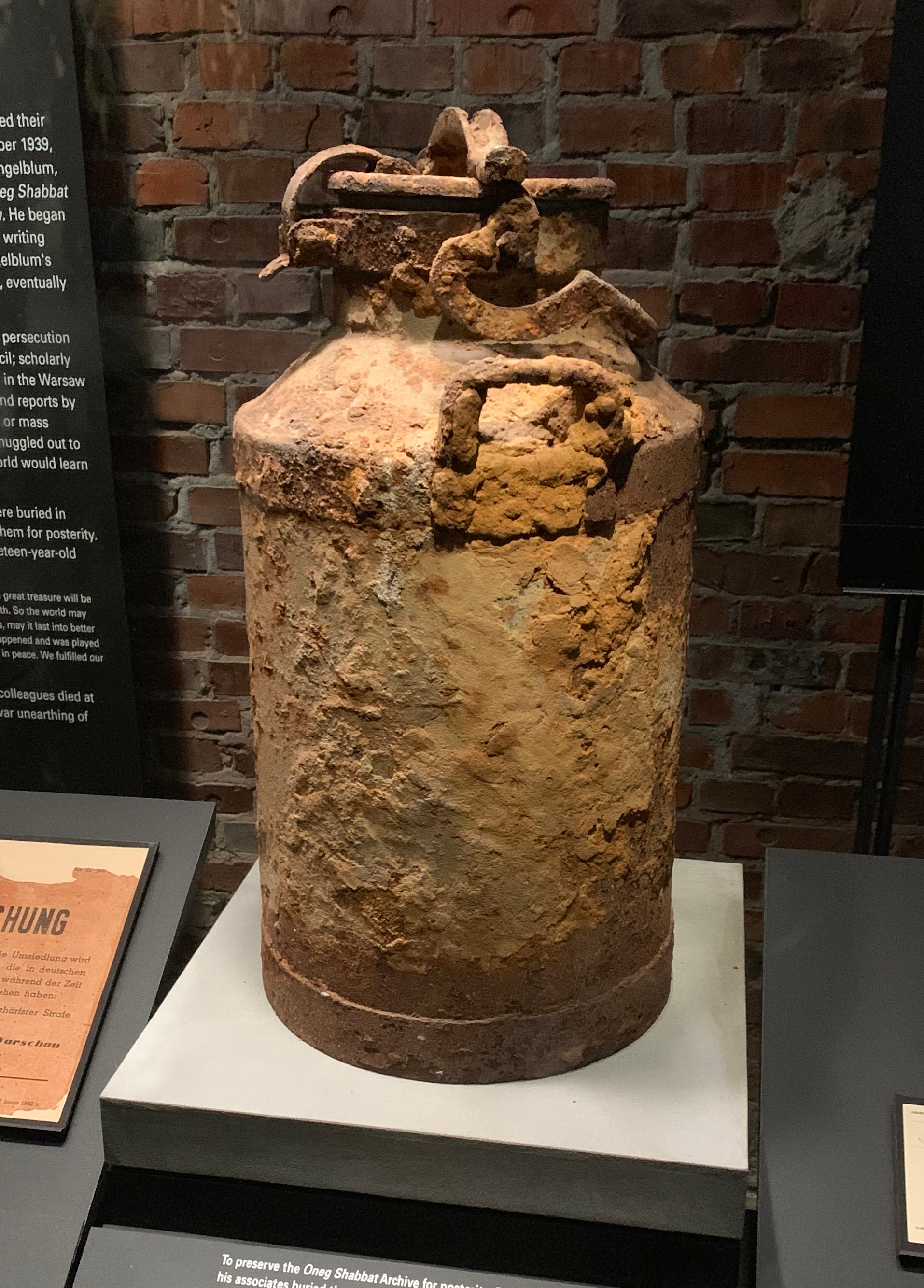
The buried milk jug (above) in the Warsaw ghetto was one of the most moving objects for me. Perhaps knowing that they might die soon of starvation or face other cruel forms of death a Jewish historian, Emanuel Ringelblum, collected and buried important documents, art, and stories of the Jewish ghetto to be found later. Their hope was it would serve as a testimony of what happened, even if they did not survive. God how that moved me. Their deaths would not silence their stories. This jar was found in 1950. I found it symbolic of quiet defiance and also of hope that their culture would live on in their diverse individual stories and art.
The other aspect that was reinforced to me is that the Holocaust (like many other stories) is not a simple story of good and evil. It is far more complex, and this is a good reason to ensure multiple narratives are told in museums. Touring the Americans and the Holocaust exhibit you are driven to understand that there are conflicting narratives; people of sympathy but inaction, caring but isolationist, crusader but ineffective, brave but ridiculed, activist but hobbled, evil but cloaked in righteousness. The complete spectrum of the human capability for deep compassion to the cruel dark aspects of hatred was laid out for the generations of today to draw lessons from what happened.
If there is one thing I have learned about history museums is that no story is easy to tell quickly or very linear without being in danger of a single narrative. The stories have to be woven together in a tapestry of perspectives to give a deep, rich meaning. The trick is how to do this with emotional impact, clarity, brevity, and interest for the range of knowledge and backgrounds that visitors enter with. The US Holocaust Memorial Museum has accomplished this with amazing thoughtfulness, research, prototyping and listening to their audience. The use of technology to engage visitors with these multiple stories was also intriguing and I plan to bring some of these techniques back to my museum staff.
 Dave's Museum Journeys
Wow, that milk can. The power of objects never ceases to amaze me. My grandparents were dairy farmers, and there were milk cans similar to that one in the barn on their farm when I was growing up. Seeing that rusted and decayed can elides the experience of the Jewish people in the Warsaw ghetto with my family’s life in rural North Carolina during exactly the same period. Do you think that part of the reason the curators chose to display that object is because it was so familiar?
LikeLike
Stephanie, familiar objects always seem to be the most powerful due to their connection to the every day life of most people. I think this also speaks to the urgency and intensity of what was going on. I imagined myself trying to find objects around me that could be buried for who knows how long and yet preserve these powerful stories and important documents inside them. Can you imagine the emotions going on when they were burying these cans? Its gut wrenching to me.
LikeLike