
Today was a day of taking objects and their myriad of facades and dissecting them to build different stories. In another interesting talk we heard about the emerging idea of the Smithsonian reaching out to collaborate with other institutions to create a central hub of information for collections. Technology and forward thinking are changing how museums tell stories. However, new technology is not a panacea for persistent museum problems and I personally feel that we are in danger of destroying or distorting stories in terrible ways.
I find it disturbing that in the digital museum age that we are neglecting part of the past. It’s all about ‘the new software program’ while I see archived media in old technologies sit neglected for lack of resources. I saw it again today. Row upon row of archives lay in quiet rooms while deteriorating, rotting, and waiting to be saved to newer media. The ‘new media’ of ten years ago is now outdated and yet again must be transferred to an even newer media. I fear we are losing the battle. I heard today from Judy Landau, JHU Internship Coordinator, that objects only exist in museums to get at the stories of the people that are behind them. If a film rots, a music record breaks, or a paper archive disintegrates in a curator’s hands…a museum object may lose its context. The storyteller has no research to go to and the story of the object becomes mute. The story behind an object becomes debatable conjecture or at its worst, an unanswered question mark. History museums are full of these objects in their collections. We should not only be collaborating on how to share information about objects but how to save supporting research from dying with much more urgency.
My other concern is our stories are often becoming paraphrased. Our long discussion of this in the morning was fascinating debate. When you dissect an object to get at a story what do you extrapolate from it to put on a label that will be read in 2 to 5 seconds from a visitor? What responsibility does a museum have to take the dissection of that object’s story deeper or keep it whole and complete? These are tough questions but we should always be ready to go beyond the label and tell the story of the object in more meaningful and different ways.
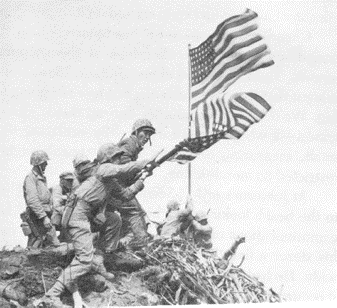
Let me illustrate the power of archives by two pictures below. Both of these pictures came from the docent’s WWII gallery guide at the National Museum of the Marine Corps. The first picture below I guarantee you have seen. It is the iconic picture of six Marines raising an American flag in WWII on the island of Iwo Jima. The flag (object) hangs in the National Museum of the Marine Corps. However, did you know that just out of frame on the right side of the famous picture is another flag being lowered? That is where the second picture below comes in. What many people don’t know about this story is there was a flag raised before the famous picture. The second picture below proves the first flag was lowered at the same time the more famous second flag was raised. I can never look at that famous photo or the famous (second) flag without thinking about what is just out of frame. What if we didn’t preserve the negative of that second picture? Proof would instantly become conjecture. One archived image can change the entire story of the object. That is the power of preserving archives.

 Dave's Museum Journeys
Dave, I can’t wait to work with you in Curatorship! I am all about the image that is just outside the frame, the back of the page, what’s written on the fly leaf of the book…what can be scary about digitizing is the material that gets left behind. When I worry about that, though, I am sometimes oddly comforted by thinking about how much has already been left behind–we have always been choosing to archive and preserve this and not that. Much, much more has been lost than has been kept…and I guess the way that I think about our cultural work is to make sure to do what we can on our watch to keep what we think matters. And then soon enough it will be someone else’s turn! What do you think?
LikeLike
Stephanie, excellent points you have made. We can never save everything for everyone for all time. The museum world would implode on itself. I think what bothers me is that if it’s in an archive there was some sort of vetting that came to the conclusion that whatever it is needed to be saved. Those languishing archives seem to be calling out…are you really going to save me?
LikeLike
It’s true–finding a way to make enough information accessible for researchers so that they will know that it’s worth digging is a challenge, but such an important task!
LikeLike